
5. 模型融合
模型融合是在比赛后期一个重要的环节,
1. **简单加权融合**:
    + 回归:算术平均融合,几何平均融合
    + 分类:投票
    + 综合:排序融合,log融合

2. **stacking/blending**:
+ 构建多层模型,并利用预测结果再拟合预测- boosting/bagging:
+ 多树的提升方法
5.1 Stacking相关理论介绍
stacking: 用初始训练数据学习出若干个基学习器后,将这几个学习器的预测结果作为新的训练集,来学习一个新的学习器。
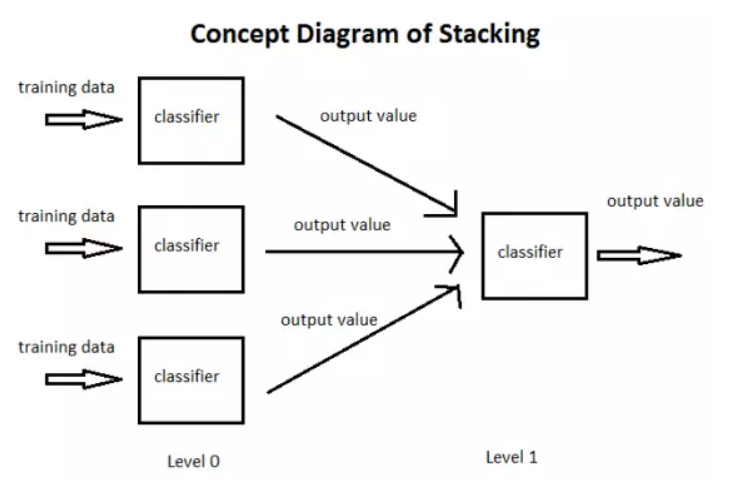
将个体学习器结合在一起的时候使用的方法叫做结合策略。对于分类问题,我们使用投票法来选择输出最多的类。对于回归问题,我们可以将分类器输出的结果求平均值。
另一个结合策略就是Stacking,使用另外一个机器学习算法来将个体结合在一起。
5.2 代码示例
5.2.1 回归\分类概率-融合
简单加权平均,结果直接融合
1
2
3
4
5
6
7
## 生成一些简单的样本数据,test_prei 代表第i个模型的预测值
test_pre1 = [1.2, 3.2, 2.1, 6.2]
test_pre2 = [0.9, 3.1, 2.0, 5.9]
test_pre3 = [1.1, 2.9, 2.2, 6.0]
# y_test_true 代表第模型的真实值
y_test_true = [1, 3, 2, 6]
1
2
3
4
5
6
7
import numpy as np
import pandas as pd
## 定义结果的加权平均函数
def Weighted_method(test_pre1,test_pre2,test_pre3,w=[1/3,1/3,1/3]):
Weighted_result = w[0]*pd.Series(test_pre1)+w[1]*pd.Series(test_pre2)+w[2]*pd.Series(test_pre3)
return Weighted_result
1
2
3
4
5
from sklearn import metrics
# 各模型的预测结果计算MAE
print('Pred1 MAE:',metrics.mean_absolute_error(y_test_true, test_pre1))
print('Pred2 MAE:',metrics.mean_absolute_error(y_test_true, test_pre2))
print('Pred3 MAE:',metrics.mean_absolute_error(y_test_true, test_pre3))
1
2
3
out: Pred1 MAE: 0.175
Pred2 MAE: 0.075
Pred3 MAE: 0.1
1
2
3
4
## 根据加权计算MAE
w = [0.3,0.4,0.3] # 定义比重权值
Weighted_pre = Weighted_method(test_pre1,test_pre2,test_pre3,w)
print('Weighted_pre MAE:',metrics.mean_absolute_error(y_test_true, Weighted_pre))
out: Weighted_pre MAE: 0.0575
可以发现通过加权融合相对于之前的结果是有提升的。
还有一些特殊的形式,比如**mean平均**、**median平均**
2. Stacking融合(回归)
1
2
3
4
5
6
from sklearn import linear_model
def Stacking_method(train_reg1,train_reg2,train_reg3,y_train_true,test_pre1,test_pre2,test_pre3,model_L2= linear_model.LinearRegression()):
model_L2.fit(pd.concat([pd.Series(train_reg1),pd.Series(train_reg2),pd.Series(train_reg3)],axis=1).values,y_train_true)
Stacking_result = model_L2.predict(pd.concat([pd.Series(test_pre1),pd.Series(test_pre2),pd.Series(test_pre3)],axis=1).values)
return Stacking_result
1
2
3
4
5
6
7
8
9
10
11
12
13
## 生成一些简单的样本数据,test_prei 代表第i个模型的预测值
train_reg1 = [3.2, 8.2, 9.1, 5.2]
train_reg2 = [2.9, 8.1, 9.0, 4.9]
train_reg3 = [3.1, 7.9, 9.2, 5.0]
# y_test_true 代表第模型的真实值
y_train_true = [3, 8, 9, 5]
test_pre1 = [1.2, 3.2, 2.1, 6.2]
test_pre2 = [0.9, 3.1, 2.0, 5.9]
test_pre3 = [1.1, 2.9, 2.2, 6.0]
# y_test_true 代表第模型的真实值
y_test_true = [1, 3, 2, 6]
1
2
3
4
model_L2= linear_model.LinearRegression()
Stacking_pre = Stacking_method(train_reg1,train_reg2,train_reg3,y_train_true,
test_pre1,test_pre2,test_pre3,model_L2)
print('Stacking_pre MAE:',metrics.mean_absolute_error(y_test_true, Stacking_pre))
1
out: Stacking_pre MAE: 0.0421348314607
可以发现模型结果相对于之前有进一步的提升,这是我们需要注意的一点是,对于**第二层Stacking的模型不宜选取的过于复杂**,这样会导致模型在训练集上过拟合,从而使得在测试集上并不能达到很好的效果。5.2.2 分类模型融合
对于分类,同样的可以使用融合方法,比如简单投票、Stacking
1 | from sklearn.datasets import make_blobs |
Voting投票机制
分为软投票和硬投票两种,原理是少数服从多数的思想
1
2
3
4
5
6
7
8
9
10
11
12
13
14
15
16
17
18
19
20'''
硬投票:对多个模型直接进行投票,不区分模型结果的相对重要度,最终投票数最多的类为最终被预测的类。
'''
iris = datasets.load_iris()
x=iris.data
y=iris.target
x_train,x_test,y_train,y_test=train_test_split(x,y,test_size=0.3)
clf1 = XGBClassifier(learning_rate=0.1, n_estimators=150, max_depth=3, min_child_weight=2, subsample=0.7,
colsample_bytree=0.6, objective='binary:logistic')
clf2 = RandomForestClassifier(n_estimators=50, max_depth=1, min_samples_split=4,
min_samples_leaf=63,oob_score=True)
clf3 = SVC(C=0.1)
# 硬投票
eclf = VotingClassifier(estimators=[('xgb', clf1), ('rf', clf2), ('svc', clf3)], voting='hard')
for clf, label in zip([clf1, clf2, clf3, eclf], ['XGBBoosting', 'Random Forest', 'SVM', 'Ensemble']):
scores = cross_val_score(clf, x, y, cv=5, scoring='accuracy')
print("Accuracy: %0.2f (+/- %0.2f) [%s]" % (scores.mean(), scores.std(), label))1
2
3
4
5
6
7
8
9
10
11
12
13
14
15
16
17
18
19
20'''
软投票:和硬投票原理相同,增加了设置权重的功能,可以为不同模型设置不同权重,进而区别模型不同的重要度。
'''
x=iris.data
y=iris.target
x_train,x_test,y_train,y_test=train_test_split(x,y,test_size=0.3)
clf1 = XGBClassifier(learning_rate=0.1, n_estimators=150, max_depth=3, min_child_weight=2, subsample=0.8,
colsample_bytree=0.8, objective='binary:logistic')
clf2 = RandomForestClassifier(n_estimators=50, max_depth=1, min_samples_split=4,
min_samples_leaf=63,oob_score=True)
clf3 = SVC(C=0.1, probability=True)
# 软投票
eclf = VotingClassifier(estimators=[('xgb', clf1), ('rf', clf2), ('svc', clf3)], voting='soft', weights=[2, 1, 1])
clf1.fit(x_train, y_train)
for clf, label in zip([clf1, clf2, clf3, eclf], ['XGBBoosting', 'Random Forest', 'SVM', 'Ensemble']):
scores = cross_val_score(clf, x, y, cv=5, scoring='accuracy')
print("Accuracy: %0.2f (+/- %0.2f) [%s]" % (scores.mean(), scores.std(), label))- 分类的Stacking\Blending融合
stacking是一种分层模型集成框架,以两层为例,第一层由多个基学习器组成,其输入为原始训练集,第二层的模型则是以第一层基学习器的输出作为训练集进行再训练,从而得到完整的stacking模型, stacking两层模型都使用了全部的训练数据。
1
2
3
4
5
6
7
8
9
10
11
12
13
14
15
16
17
18
19
20
21
22
23
24
25
26
27
28
29
30
31
32
33
34
35
36
37
38
39
40
41
42
43
44
45
46
47
48
49
50'''
5-Fold Stacking
'''
from sklearn.ensemble import RandomForestClassifier
from sklearn.ensemble import ExtraTreesClassifier,GradientBoostingClassifier
import pandas as pd
#创建训练的数据集
data_0 = iris.data
data = data_0[:100,:]
target_0 = iris.target
target = target_0[:100]
#模型融合中使用到的各个单模型
clfs = [LogisticRegression(solver='lbfgs'),
RandomForestClassifier(n_estimators=5, n_jobs=-1, criterion='gini'),
ExtraTreesClassifier(n_estimators=5, n_jobs=-1, criterion='gini'),
ExtraTreesClassifier(n_estimators=5, n_jobs=-1, criterion='entropy'),
GradientBoostingClassifier(learning_rate=0.05, subsample=0.5, max_depth=6, n_estimators=5)]
#切分一部分数据作为测试集
X, X_predict, y, y_predict = train_test_split(data, target, test_size=0.3, random_state=2020)
dataset_blend_train = np.zeros((X.shape[0], len(clfs)))
dataset_blend_test = np.zeros((X_predict.shape[0], len(clfs)))
#5折stacking
n_splits = 5
skf = StratifiedKFold(n_splits)
skf = skf.split(X, y)
for j, clf in enumerate(clfs):
#依次训练各个单模型
dataset_blend_test_j = np.zeros((X_predict.shape[0], 5))
for i, (train, test) in enumerate(skf):
#5-Fold交叉训练,使用第i个部分作为预测,剩余的部分来训练模型,获得其预测的输出作为第i部分的新特征。
X_train, y_train, X_test, y_test = X[train], y[train], X[test], y[test]
clf.fit(X_train, y_train)
y_submission = clf.predict_proba(X_test)[:, 1]
dataset_blend_train[test, j] = y_submission
dataset_blend_test_j[:, i] = clf.predict_proba(X_predict)[:, 1]
#对于测试集,直接用这k个模型的预测值均值作为新的特征。
dataset_blend_test[:, j] = dataset_blend_test_j.mean(1)
print("val auc Score: %f" % roc_auc_score(y_predict, dataset_blend_test[:, j]))
clf = LogisticRegression(solver='lbfgs')
clf.fit(dataset_blend_train, y)
y_submission = clf.predict_proba(dataset_blend_test)[:, 1]
print("Val auc Score of Stacking: %f" % (roc_auc_score(y_predict, y_submission)))Blending:其实和Stacking是一种类似的多层模型融合的形式。其主要思路是把原始的训练集先分成两部分,比如70%的数据作为新的训练集,剩下30%的数据作为测试集。在第一层,我们在这70%的数据上训练多个模型,然后去预测那30%数据的label,同时也预测test集的label。在第二层,我们就直接用这30%数据在第一层预测的结果做为新特征继续训练,然后用test集第一层预测的label做特征,用第二层训练的模型做进一步预测
其优点在于:
- 1.比stacking简单(因为不用进行k次的交叉验证来获得stacker feature)
- 2.避开了一个信息泄露问题:generlizers和stacker使用了不一样的数据集
缺点在于:
- 1.使用了很少的数据(第二阶段的blender只使用training set10%的量)
- 2.blender可能会过拟合
- 3.stacking使用多次的交叉验证会比较稳健
1
2
3
4
5
6
7
8
9
10
11
12
13
14
15
16
17
18
19
20
21
22
23
24
25
26
27
28
29
30
31
32
33
34
35
36
37
38
39
40
41
42'''
Blending
'''
#创建训练的数据集
#创建训练的数据集
data_0 = iris.data
data = data_0[:100,:]
target_0 = iris.target
target = target_0[:100]
#模型融合中使用到的各个单模型
clfs = [LogisticRegression(solver='lbfgs'),
RandomForestClassifier(n_estimators=5, n_jobs=-1, criterion='gini'),
RandomForestClassifier(n_estimators=5, n_jobs=-1, criterion='entropy'),
ExtraTreesClassifier(n_estimators=5, n_jobs=-1, criterion='gini'),
#ExtraTreesClassifier(n_estimators=5, n_jobs=-1, criterion='entropy'),
GradientBoostingClassifier(learning_rate=0.05, subsample=0.5, max_depth=6, n_estimators=5)]
#切分一部分数据作为测试集
X, X_predict, y, y_predict = train_test_split(data, target, test_size=0.3, random_state=2020)
#切分训练数据集为d1,d2两部分
X_d1, X_d2, y_d1, y_d2 = train_test_split(X, y, test_size=0.5, random_state=2020)
dataset_d1 = np.zeros((X_d2.shape[0], len(clfs)))
dataset_d2 = np.zeros((X_predict.shape[0], len(clfs)))
for j, clf in enumerate(clfs):
#依次训练各个单模型
clf.fit(X_d1, y_d1)
y_submission = clf.predict_proba(X_d2)[:, 1]
dataset_d1[:, j] = y_submission
#对于测试集,直接用这k个模型的预测值作为新的特征。
dataset_d2[:, j] = clf.predict_proba(X_predict)[:, 1]
print("val auc Score: %f" % roc_auc_score(y_predict, dataset_d2[:, j]))
#融合使用的模型
clf = GradientBoostingClassifier(learning_rate=0.02, subsample=0.5, max_depth=6, n_estimators=30)
clf.fit(dataset_d1, y_d2)
y_submission = clf.predict_proba(dataset_d2)[:, 1]
print("Val auc Score of Blending: %f" % (roc_auc_score(y_predict, y_submission)))- 分类的Stacking融合
1
2
3
4
5
6
7
8
9
10
11
12
13
14
15
16
17
18
19
20
21
22
23
24
25
26
27
28
29
30
31
32
33
34
35
36
37
38
39
40
41
42
43
44
45
46
47
48
49
50
51
52
53
54
!pip install mlxtend
import warnings
warnings.filterwarnings('ignore')
import itertools
import numpy as np
import seaborn as sns
import matplotlib.pyplot as plt
import matplotlib.gridspec as gridspec
from sklearn import datasets
from sklearn.linear_model import LogisticRegression
from sklearn.neighbors import KNeighborsClassifier
from sklearn.naive_bayes import GaussianNB
from sklearn.ensemble import RandomForestClassifier
from mlxtend.classifier import StackingClassifier
from sklearn.model_selection import cross_val_score
from mlxtend.plotting import plot_learning_curves
from mlxtend.plotting import plot_decision_regions
# 以python自带的鸢尾花数据集为例
iris = datasets.load_iris()
X, y = iris.data[:, 1:3], iris.target
clf1 = KNeighborsClassifier(n_neighbors=1)
clf2 = RandomForestClassifier(random_state=1)
clf3 = GaussianNB()
lr = LogisticRegression()
sclf = StackingClassifier(classifiers=[clf1, clf2, clf3],
meta_classifier=lr)
label = ['KNN', 'Random Forest', 'Naive Bayes', 'Stacking Classifier']
clf_list = [clf1, clf2, clf3, sclf]
fig = plt.figure(figsize=(10,8))
gs = gridspec.GridSpec(2, 2)
grid = itertools.product([0,1],repeat=2)
clf_cv_mean = []
clf_cv_std = []
for clf, label, grd in zip(clf_list, label, grid):
scores = cross_val_score(clf, X, y, cv=3, scoring='accuracy')
print("Accuracy: %.2f (+/- %.2f) [%s]" %(scores.mean(), scores.std(), label))
clf_cv_mean.append(scores.mean())
clf_cv_std.append(scores.std())
clf.fit(X, y)
ax = plt.subplot(gs[grd[0], grd[1]])
fig = plot_decision_regions(X=X, y=y, clf=clf)
plt.title(label)
plt.show()
5.2.3 一些其他方法
将特征放进模型中预测,并将预测结果变换并作为新的特征加入原有特征中再经过模型预测结果。
1 | def Ensemble_add_feature(train,test,target,clfs): |
1 | from sklearn.model_selection import cross_val_score, train_test_split |
5.4 经验总结
比赛的融合这个问题,个人的看法来说其实涉及多个层面,也是提分和提升模型鲁棒性的一种重要方法:
- 1)结果层面的融合,这种是最常见的融合方法,其可行的融合方法也有很多,比如根据结果的得分进行加权融合,还可以做Log,exp处理等。在做结果融合的时候,有一个很重要的条件是模型结果的得分要比较近似,然后结果的差异要比较大,这样的结果融合往往有比较好的效果提升。
- 2)特征层面的融合,这个层面其实感觉不叫融合,准确说可以叫分割,很多时候如果我们用同种模型训练,可以把特征进行切分给不同的模型,然后在后面进行模型或者结果融合有时也能产生比较好的效果。
- 3)模型层面的融合,模型层面的融合可能就涉及模型的堆叠和设计,比如加Staking层,部分模型的结果作为特征输入等,这些就需要多实验和思考了,基于模型层面的融合最好不同模型类型要有一定的差异,用同种模型不同的参数的收益一般是比较小的。